
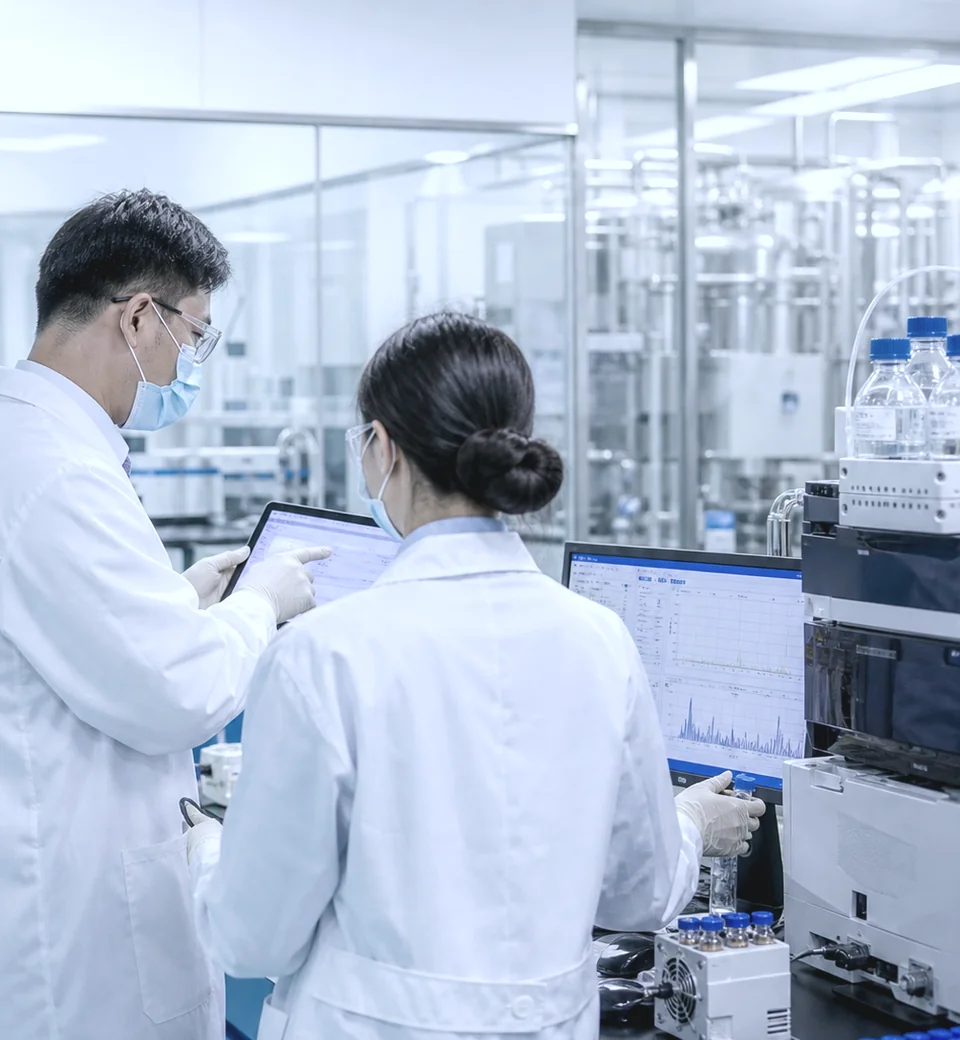
Solvent demand becomes a much larger operational issue as peptide projects move from laboratory work toward multi-kilogram production. The chemistry may remain familiar, but the volume of solvents used for reactions, washing, purification, and equipment cleaning can increase sharply.
For peptide suppliers, this makes resource efficiency relevant not only to environmental goals but also to production planning, waste handling, cost control, and facility capacity. At UTIDE, we approach process development with these practical factors in mind, particularly as projects require methods that can perform beyond small experimental batches.
Why Scale Changes Solvent Requirements
Laboratory experiments often use solvent volumes that appear manageable because the batch itself is small. At larger scale, the same ratio can translate into hundreds or thousands of liters across repeated processing steps. The resulting waste stream may require additional collection, storage, treatment, and transportation.
Solid-phase peptide synthesis can be especially solvent-intensive because each cycle may involve reaction, deprotection, and resin-washing operations. A long sequence can contain many repeated cycles, so modest reductions at individual steps may have a noticeable effect across the whole batch.
For peptide manufacturers, the key question is not simply how much solvent can be removed. Process teams must also consider resin swelling, reagent distribution, reaction concentration, impurity formation, and purification performance. A reduction that changes reaction behavior may create new technical problems elsewhere.
Practical Routes to Solvent Reduction
One approach is to examine solvent-to-material ratios at each stage. Higher reaction concentrations can sometimes reduce volume, although the suitable range depends on peptide sequence, resin characteristics, reagent solubility, and mixing conditions. Development work can identify where concentration changes remain technically practical.
Washing steps provide another area for investigation. Repeated washes are important for removing residual reagents and by-products, yet their volume and frequency may sometimes be optimized. Such changes need analytical support because a smaller wash volume is useful only if the resulting material remains within the required quality range.
Purification can also influence the overall solvent footprint. Chromatographic separation may consume substantial mobile-phase volumes, particularly when crude peptide loads increase. Improving crude quality before purification, optimizing loading conditions, or evaluating alternative separation strategies can sometimes reduce downstream solvent demand.
Balancing Sustainability With Product Quality
Green chemistry does not mean that every conventional solvent should simply be replaced. Different solvents can behave differently in reaction kinetics, peptide solubility, resin swelling, and impurity formation. A substitution that works for one sequence may not perform similarly with another.
Residual solvent control also remains important after process changes. Solvents used during synthesis or purification can remain in the final material if removal conditions are insufficient. Analytical testing provides evidence about whether a modified process has changed the residual solvent profile.
For peptide suppliers, sustainability claims are more useful when they can be connected with measurable process data. Solvent consumption per batch, solvent use per kilogram of product, recovery rates, waste volume, and analytical results can provide a clearer basis for evaluating whether a change has delivered a practical benefit.
Preparing for Larger-Scale Production
Scale-up offers an opportunity to review solvent use before inefficient habits become embedded in a manufacturing process. Development teams can identify high-consumption operations early and assess whether concentration, washing, recovery, or purification strategies can be adjusted.
Equipment also matters. Mixing, heat transfer, filtration, solvent recovery, and drying may behave differently as vessel size increases. A solvent strategy that works in a small reactor may require modification when the same chemistry is transferred to larger equipment.
Our team at UTIDE has supported more than 10 multi-kg scale projects. We use process development, purification strategy, and impurity control to examine how technical changes behave as production requirements increase. This experience helps us consider solvent efficiency alongside process performance rather than treating resource reduction as a separate exercise.
What Buyers Should Discuss With Suppliers
Sustainability can become part of supplier evaluation without replacing conventional technical criteria. Buyers may ask how a manufacturing route manages solvent consumption, whether solvent recovery is available, how waste streams are handled, and whether process optimization has been considered during development.
The quality system surrounding these activities matters as well. Any meaningful process modification should be assessed for its possible effects on purity, impurities, residual solvents, yield, and reproducibility. Documentation allows buyers to understand what changed and why the revised conditions remain appropriate.
Future production models may increasingly combine chemical efficiency with practical resource management. Peptide manufacturers that understand the relationship between solvent use, process conditions, scale, and quality will be better positioned to discuss sustainability in concrete technical terms rather than relying on broad environmental statements.
Conclusion
Solvent reduction is becoming a process-development question as much as an environmental one. The most useful improvements often come from examining repeated operations, scale-sensitive conditions, purification demand, and measurable waste streams together.
Buyers can use these factors when comparing peptide suppliers, while peptide manufacturers can treat resource efficiency as part of broader process knowledge. At UTIDE, we continue to apply our multi-kg project experience to development work where manufacturing practicality, analytical control, and more efficient use of resources need to develop side by side.