
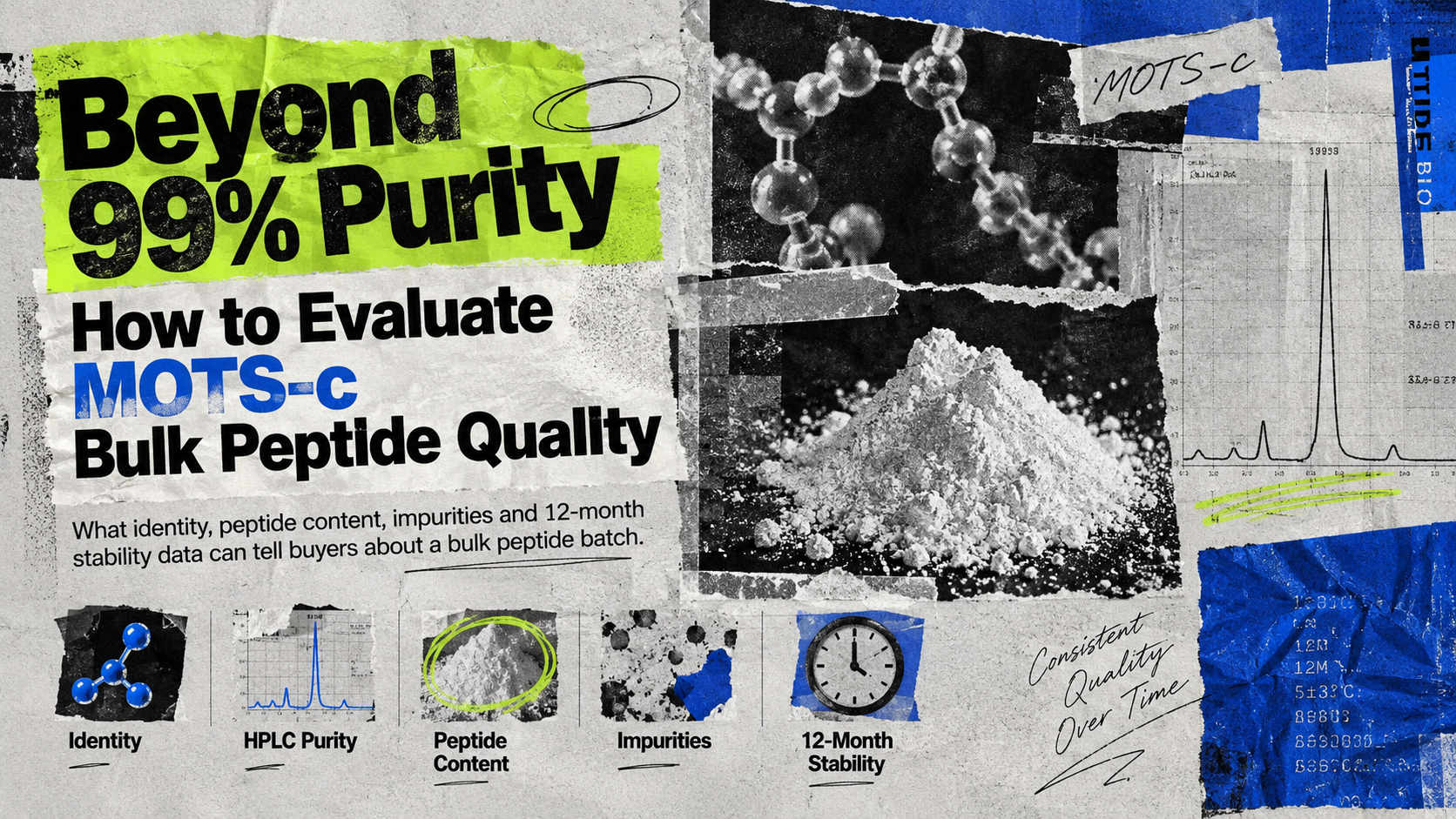
Beyond 99% Purity: How to Evaluate MOTS c Bulk Peptide Quality
What identity, peptide content, impurities and stability data can tell buyers about a bulk peptide batch
MOTS-c has attracted growing interest in research. As more bulk peptide suppliers enter the market, buyers often see a familiar number on a Certificate of Analysis (CoA): HPLC purity above 99%. That is useful information, but it answers only one part of the quality question. A practical assessment also asks whether the material is the right molecule, how much peptide is in the powder as supplied, what else is present, and whether results remain consistent over time and across batches.
Start with identity
A purity result describes the share of the chromatogram attributed to the main peak under a particular HPLC method. It does not, by itself, establish that the main peak is MOTS-c. Mass spectrometry provides a separate check of molecular identity. Buyers should ask for the CoA and appropriate identity data tied to the actual batch under discussion.
Understand what 99% purity means
HPLC purity is usually an area percentage: how much of the measured chromatogram belongs to the main peak. Peptide content answers a different question: in 100 grams of the supplied powder, approximately how much is the peptide? Water, counterions and other components affect that number. A material can therefore show more than 99% HPLC purity while its peptide content is lower. This distinction matters when comparing quotations, calculating research quantities or checking batch consistency.
Look at impurities as well as the main peak
A single purity figure does not show the whole impurity pattern. Total impurities, the largest individual impurity and changes in the profile can all inform a buyer’s assessment. A meaningful CoA reports a defined specification and a result for the relevant batch; technical review can then explore the supporting chromatogram and analytical method where appropriate.
Use stability data to see what happens over time
A CoA is a snapshot at release. A stability study checks the material again at set intervals under defined storage conditions. It helps answer whether the same material stays within its specifications during the stated period. For a non-specialist, the question is simple: does the product still meet its limits after months in storage?
The table below is an anonymized, rounded illustration drawn from three Utide MOTS-c acetate batches held in white HDPE containers at refrigerated temperature, 5 ± 3°C. It summarizes selected 12-month observations rather than replacing a complete study report or a batch-specific CoA.
| Question for the buyer | Illustrative 12 month observation | Why it matters |
| Is the main peak still dominant? | All three batches remained above 99% HPLC purity. | Tracks the measured main peak over time. |
| Did impurities grow? | Total impurities rose modestly and remained below 2%. | Shows whether the impurity profile is changing. |
| How much peptide is in the powder? | Peptide content was always greater than 80%. | Makes clear that purity and peptide content differ. |
| Did moisture change? | Water increased slightly and remained far below the limit. | Checks a component that can affect content and handling. |
These observations apply only to the studied batches and conditions. They do not establish sterility, suitability for human use, or a regulatory status for MOTS-c.
Ask whether the process repeats across batches
One good batch is encouraging. Three batches with comparable identity, purity, impurity profile and peptide content offer a stronger view of manufacturing consistency. The buyer should still evaluate the actual batch offered for purchase and confirm that its lot number matches the CoA and any supporting test records.
A short checklist for bulk peptide buyers
- Confirm the exact peptide, salt form and intended use.
- Match the CoA and analytical results to the batch being supplied.
- Review identity, HPLC purity, impurity profile, peptide content and water separately.
- Ask what stability data exist for the proposed packaging and storage conditions.
- Clarify the manufacturing quality system and the material’s actual regulatory status.
Utide manufactures non-sterile bulk peptides and applies defined specifications and analytical controls to its material. We can discuss batch-specific documentation and the appropriate supply route after understanding a customer’s project and intended use.