
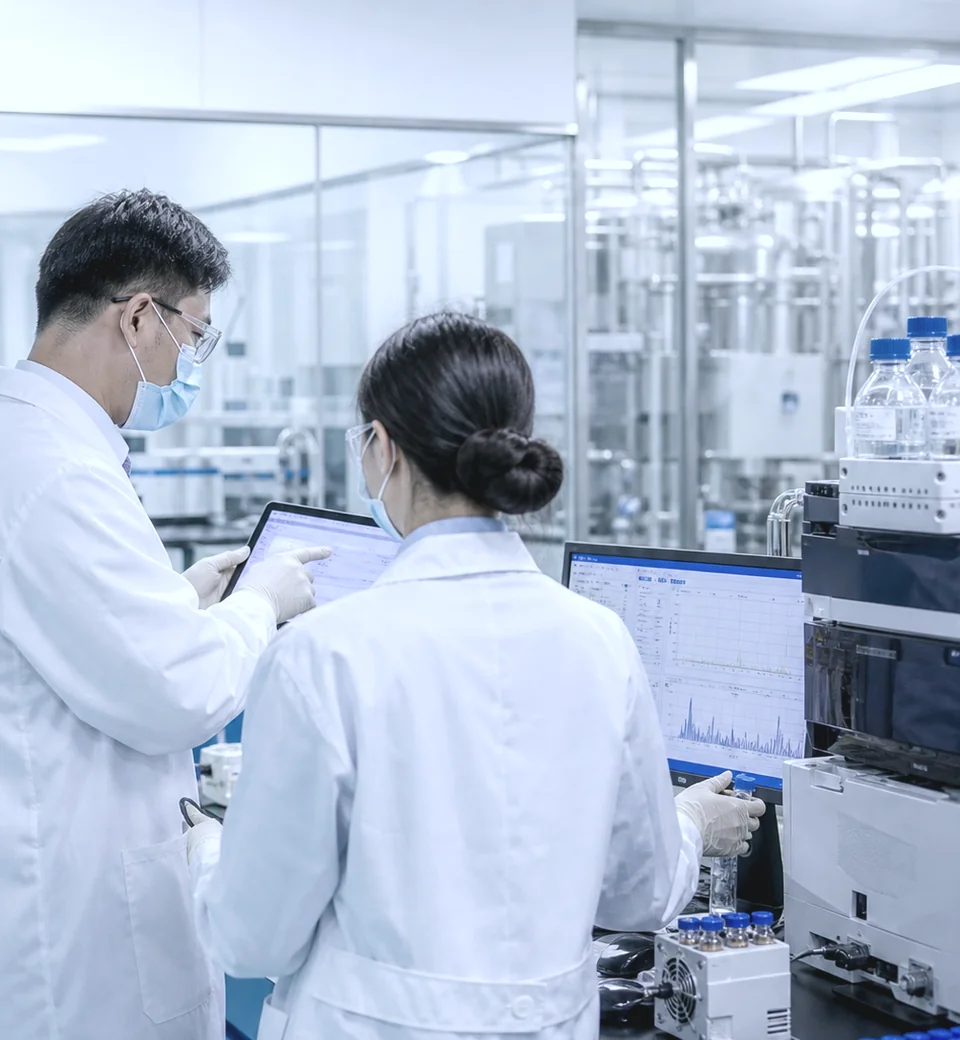
Scale-up decisions become more complex once a peptide project moves beyond early laboratory batches. UTIDE approaches peptide development and manufacturing as a connected process, so we consider chemistry, purification, analytical work, production conditions, and quality requirements together. For buyers reviewing a peptide manufacturer, the key question is not simply whether a facility can produce a peptide, but whether its development approach can support changing batch sizes and technical requirements.
Assess Process Development Capability
A successful small batch does not automatically indicate that the same process will behave well at larger scale. Changes in mixing, reaction time, reagent distribution, filtration, and material handling can affect synthesis performance. These physical differences should be considered before a process moves into a larger production environment.
Sequence complexity also deserves close attention. Long-chain structures, difficult sequences, modified peptides, and conjugated molecules can create different synthesis or purification challenges. Buyers should ask how a potential partner studies these issues and how development data is used to refine the production route.
A useful assessment goes beyond the final yield. Development records can reveal how reaction conditions were evaluated, how side reactions were investigated, and whether purification choices were tested against the expected impurity profile. This information gives buyers a clearer view of the technical foundation behind future production.
Examine Scale-Up Experience
Scale-up is not simply a matter of increasing the amount of raw material. Larger batches can change heat transfer, mixing efficiency, solvent handling, resin processing, filtration speed, and purification loads. Each factor can influence the way a process behaves under production conditions.
A practical peptide manufacturer should be able to explain how development work is transferred between scales. Buyers can ask which process parameters are monitored during this transition and how differences between small and larger batches are assessed.
The production pathway should also have sensible intermediate stages. Moving directly from a small laboratory experiment to a large batch may leave important process behavior untested. Stepwise development allows technical teams to compare yield, purity, impurity patterns, processing time, and material recovery as the scale changes.
Review Purification and Quality Control
Purification often becomes a major consideration as crude peptide volume increases. Column loading, sample concentration, solvent consumption, and impurity levels may change with batch size. A purification method must be considered in relation to the amount and characteristics of material that will actually be processed.
Quality testing adds another perspective. Purity is important, but it does not describe every quality attribute. Depending on the project, analytical work may also address identity, related impurities, residual solvents, microbial control, water content, and other product-specific characteristics.
For peptide manufacturers, the relationship between purification and analysis can be particularly informative. Analytical results may reveal changes in impurity behavior or recovery after a process adjustment. Reviewing these connections helps buyers understand whether development decisions are supported by measurable data rather than isolated production results.
Evaluate Manufacturing Support
At UTIDE, we provide peptide development and manufacturing support from process design and synthesis optimization through scale-up production and analytical quality work. We work with complex sequences and support development from milligram quantities toward multi-kilogram scale. Our quality framework includes batch traceability and analytical support for purity, impurities, residual solvents, and microbial control.
Technical communication should also be part of a buyer’s review. A project can change after initial development because specifications, production quantities, purification targets, or analytical requirements may be refined. Regular communication between technical and project teams helps these changes become part of the development record.
Documentation provides another useful checkpoint. Process information, batch records, analytical results, and traceability data allow teams to understand how material was produced and tested. Clear documentation is especially useful when several batches need to be compared during development or future production.
Build a Practical Selection Framework
Price and stated production capacity are relevant commercial factors, yet they do not provide the full picture. Buyers can also examine development depth, scale-up history, purification experience, analytical capability, quality systems, documentation, and technical communication before entering a manufacturing relationship.
When comparing peptide manufacturers, it can help to organize questions around specific evidence. Ask which scales have been demonstrated, how difficult sequences are handled, what information is generated during process development, and how process changes are reviewed before larger production.
Future supply requirements should also influence the assessment. A project may begin with research quantities and later require repeated manufacturing at higher volumes. The selected partner should have systems that can accommodate this progression while maintaining appropriate process control and traceability.
A peptide manufacturer should also be assessed according to the actual needs of the project rather than a generic checklist. Early research, development-stage programs, and larger supply projects can require different levels of documentation and analytical support. Matching the evaluation criteria to the intended stage makes the comparison more useful.
Conclusion
Scale-up readiness becomes clearer when buyers examine the path between development and production instead of focusing on facility size alone. Our team at UTIDE connects process design, scale-up development, quality systems, and technical support within our manufacturing approach. We aim to help customers understand how process decisions translate into larger production requirements.
A thoughtful peptide development and manufacturing strategy should leave a useful technical record at every stage, from early process studies to larger batches. Buyers can use that record to review reproducibility, purification behavior, analytical results, and manufacturing changes. This creates a more practical basis for evaluating whether a supplier fits the project’s next stage.
The role of peptide manufacturers continues to expand as peptide projects become more technically demanding. Process knowledge, scale-up experience, quality systems, and communication all contribute to the manufacturing relationship. We at UTIDE bring these capabilities together to support projects that need a structured path from early development toward scalable production.