
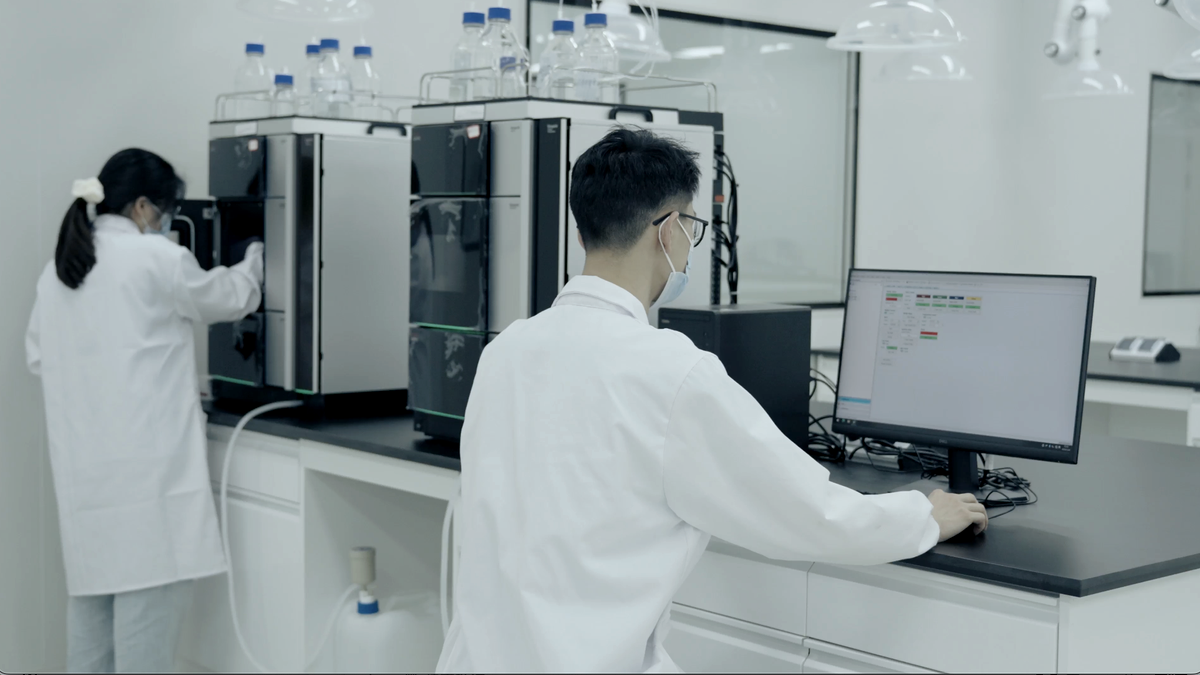
Scale changes the way a peptide reaction behaves. A mixture that looks uniform in a small vessel may develop concentration differences, slower dispersion, or localized temperature changes after the batch grows.
Such differences can affect reaction efficiency and impurity profiles, making peptide synthesis service development more than a matter of increasing reagent quantities. At UTIDE, we consider mixing behavior alongside reaction conditions so that process decisions remain practical as production moves toward larger volumes.
Why Mixing Changes With Scale
Small vessels usually have short mixing paths, while larger equipment creates greater distances between the addition point and other parts of the reaction mass. Agitation speed alone does not describe how quickly the entire mixture becomes uniform. Impeller type, vessel geometry, liquid volume, and viscosity all contribute to the final mixing pattern.
Hydrophobic or poorly soluble materials can make the situation more complicated. Local pockets of concentrated reagent may appear before the bulk liquid becomes uniform. Such conditions can increase the chance of uneven reaction progress, especially during controlled reagent addition.
Scale-up work should focus on measurable process behavior rather than simply copying laboratory settings. A useful custom peptide manufacturing strategy examines mixing time, addition rate, concentration, and temperature together. These parameters provide a stronger basis for transferring a reaction between equipment sizes.
Agitation and Reaction Uniformity
Higher agitation does not automatically produce better results. Excessive mechanical force may create foaming or other operational issues, while insufficient movement can leave stagnant regions inside the vessel. The useful range depends on the physical properties of the reaction mixture and the equipment being used.
Viscosity deserves attention as peptide concentration increases. A thicker solution can respond differently to the same impeller speed used with a dilute mixture. Sampling from different vessel locations can reveal whether the reaction has reached a sufficiently uniform state.
A practical peptide synthesis service should connect laboratory observations with scale-specific equipment parameters. Rather than treating agitation as one fixed number, development teams can evaluate how changes in mixing conditions influence reaction time, conversion, impurity formation, and material recovery.
Reagent Addition and Local Concentration
The point where a reagent enters the vessel can influence the entire reaction. Rapid addition into a poorly mixed area may create temporary high concentrations that are not reflected by a sample taken later from the bulk solution. Addition speed and location can be especially important when a reagent has limited solubility.
Controlled addition gives the reaction more time to distribute incoming material. The appropriate rate depends on vessel geometry, mixing capacity, reagent concentration, and reaction kinetics. A slower addition is not always necessary, but unexplained batch variation can make this parameter worth investigating.
Within custom peptide manufacturing, addition procedures should be documented with enough detail to support reproducibility. Recording feed rate, addition duration, agitation conditions, and sampling points gives later batches a clearer technical reference.
Equipment Geometry Matters
Two vessels with the same working volume can behave differently if their dimensions or internal components are not comparable. Impeller position, baffle arrangement, vessel diameter, and liquid height all affect circulation patterns. Scale-up decisions should account for these physical differences.
Laboratory vessels often allow rapid visual observation, while production equipment may offer fewer direct clues about what happens inside the reaction mass. Process data can compensate for this limitation by tracking measurable indicators such as mixing time and temperature response.
A sound peptide synthesis service development process treats equipment characteristics as part of the chemistry rather than as a separate manufacturing detail. This perspective helps explain why identical recipes can produce different results after moving between vessels.
Monitoring Mixing Performance
Mixing quality can be assessed through several practical indicators. Temperature response, conductivity changes, concentration measurements, and sampling from multiple locations can help reveal how quickly a vessel becomes uniform. The most suitable approach depends on the chemistry and available analytical methods.
Reaction sampling also has to be designed carefully. Samples collected too soon after an addition may describe a temporary local condition rather than the state of the full batch. Consistent sampling intervals make comparisons between development runs more meaningful.
At UTIDE, we use process observations to understand how equipment and reaction conditions interact during scale development. For custom peptide manufacturing, this information can support adjustments before larger production runs rather than relying entirely on assumptions from small-scale experiments.
From Laboratory Data to Production
Successful scale-up does not require every laboratory parameter to remain numerically identical. The more useful goal is to preserve the process conditions that matter to reaction performance. Mixing time, mass transfer, temperature control, and addition behavior may provide better scale-up references than simple agitation-speed matching.
Pilot-scale work can reveal issues that remain hidden in small vessels. Changes in liquid depth, heat removal, and circulation may influence the reaction even when the chemical recipe stays unchanged. Capturing these differences early gives process teams more information for later production planning.
For custom peptide manufacturing, scale-dependent mixing becomes part of a broader control strategy. At UTIDE, we connect reaction observations with equipment and process data so that scale-up decisions can be based on how the system actually behaves.
Conclusion
Good mixing is rarely visible in the final batch, yet its influence can extend through reaction consistency, impurity formation, and material recovery. Understanding how vessel size, fluid properties, addition methods, and agitation interact gives peptide development teams a clearer route from laboratory work to larger production. We at UTIDE treat scale-up as a process of understanding these relationships, allowing each increase in batch size to be supported by practical data rather than simple numerical repetition.