
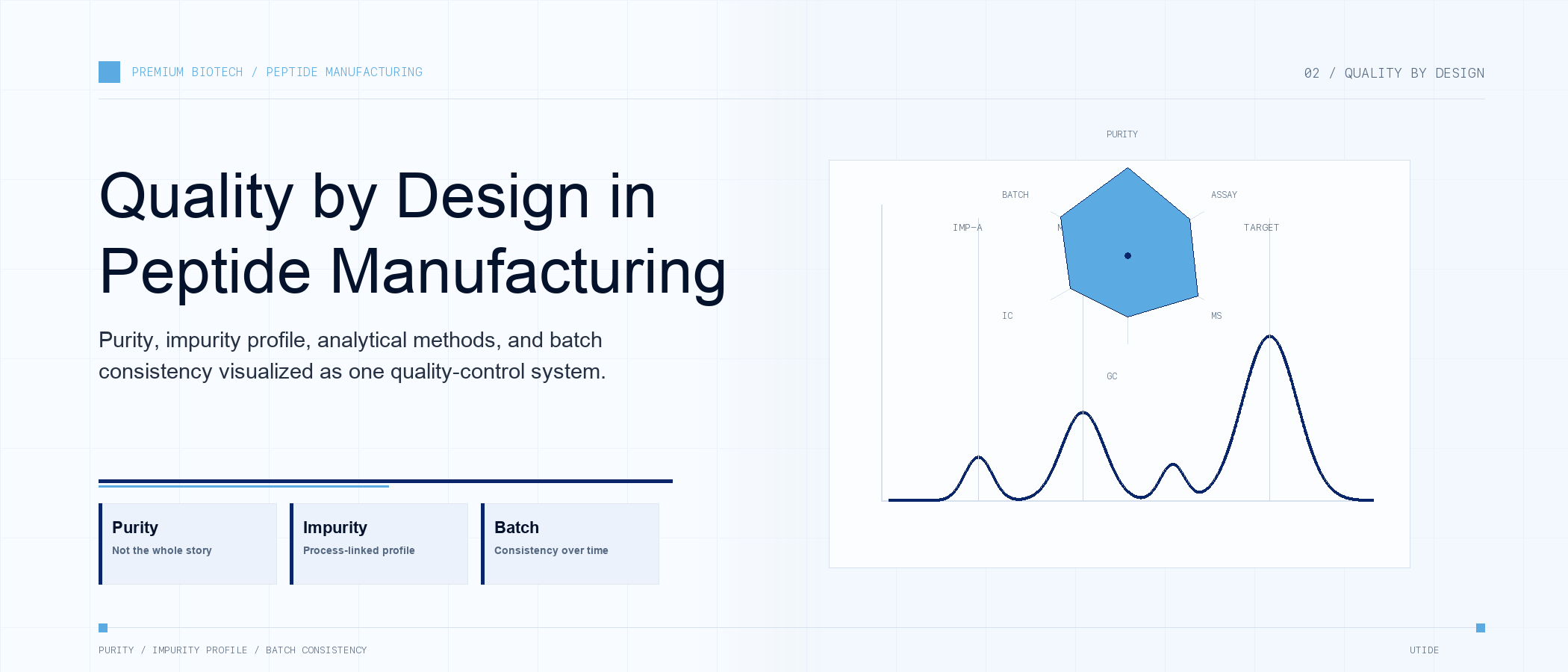
Understanding how systematic quality control supports reliable, scalable peptide manufacturing.
Peptide manufacturing is a highly technical process in which quality is shaped by every stage of production. From synthesis and cleavage to purification, salt conversion, lyophilization, and final release testing, each step can influence the final product profile.
In this context, quality cannot be treated as a final inspection activity only. It needs to be designed into the process from the beginning. This is the core idea behind a quality-by-design approach in peptide manufacturing.
For global peptide projects, the ability to manage purity, impurities, and batch-to-batch consistency is not only a technical requirement. It is also a foundation for project reliability, regulatory readiness, and long-term supply confidence.
Purity Is Important, but It Is Not the Whole Story
Purity is often the first quality indicator that customers look at when evaluating a peptide product. A high purity result is important, but it does not provide the full picture of product quality.
Peptide-related impurities may come from incomplete coupling, deletion sequences, side reactions, oxidation, deamidation, racemization, cleavage by-products, or process-related residues. Even when the main peak appears strong, understanding the impurity profile is essential for evaluating process robustness and product consistency.
Therefore, a reliable peptide quality system should not only focus on achieving a target purity level. It should also identify, monitor, and control the impurity profile throughout development and manufacturing.
Impurity Control Begins with Process Understanding
In peptide manufacturing, impurities are closely connected to process conditions. Resin selection, coupling strategy, reagent quality, reaction time, cleavage conditions, purification method, and drying parameters may all affect the final impurity profile.
When a process is transferred from small-scale development to larger-scale production, impurity behavior may also change. A minor side reaction observed during laboratory synthesis can become more significant at scale if the process is not well understood.
This is why process development and analytical development need to work together. By understanding where impurities come from and how they respond to process changes, manufacturers can build stronger control strategies and reduce batch variability.
Analytical Methods Support Manufacturing Control
Analytical capabilities are central to peptide quality control. Technologies such as HPLC and UPLC are widely used for purity and impurity analysis. MS supports molecular weight confirmation and impurity identification. GC can be used for residual solvent analysis, while IC supports the detection of counter ions and related ionic components.
For peptide projects, these tools are not isolated testing methods. Together, they help manufacturers understand the process, confirm product identity, monitor critical quality attributes, and support batch release decisions.
A strong analytical platform also helps customers evaluate whether the product is suitable for their next stage of development or supply chain use.
Batch Consistency Reflects Manufacturing Maturity
For many peptide projects, one successful batch is not enough. Customers need confidence that future batches can be produced with comparable quality, documentation, and performance.
Batch-to-batch consistency depends on controlled raw material management, defined process parameters, qualified equipment, trained operators, in-process monitoring, and reliable final testing. It also requires complete batch records and traceable data throughout the manufacturing process.
When a manufacturing process is well controlled, consistency becomes more predictable. This is especially important for long-term supply programs, repeated customer orders, and projects moving toward higher regulatory expectations.
Quality Control Extends across the Manufacturing Lifecycle
Quality control in peptide manufacturing should cover more than final product testing. It should extend across the full manufacturing lifecycle, including raw material control, process monitoring, intermediate evaluation, final release testing, stability considerations, and documentation review.
This broader view helps reduce risk. It allows manufacturers to detect potential issues earlier, make informed process adjustments, and provide customers with more reliable quality data.
For international customers, a structured quality system can also improve communication efficiency, because technical discussions are supported by clear data, defined specifications, and traceable records.
UTIDE’s Perspective on Quality-Driven Peptide Manufacturing
At UTIDE, we believe that quality is not achieved only at the end of production. It is built through process design, analytical control, manufacturing discipline, and continuous attention to batch consistency.
UTIDE supports peptide projects with integrated manufacturing and quality control capabilities, covering synthesis, purification, lyophilization, analytical testing, and documentation support. Our focus is to help global partners move peptide projects forward with reliable data, controlled processes, and stable supply support.
As peptide projects become more complex and global supply requirements continue to rise, quality-driven manufacturing will remain essential. Managing purity, impurities, and batch consistency is not simply a technical task. It is a key part of turning peptide innovation into dependable industrial supply.
In peptide manufacturing, quality is not a single test result. It is the outcome of a controlled, understood, and repeatable process.