
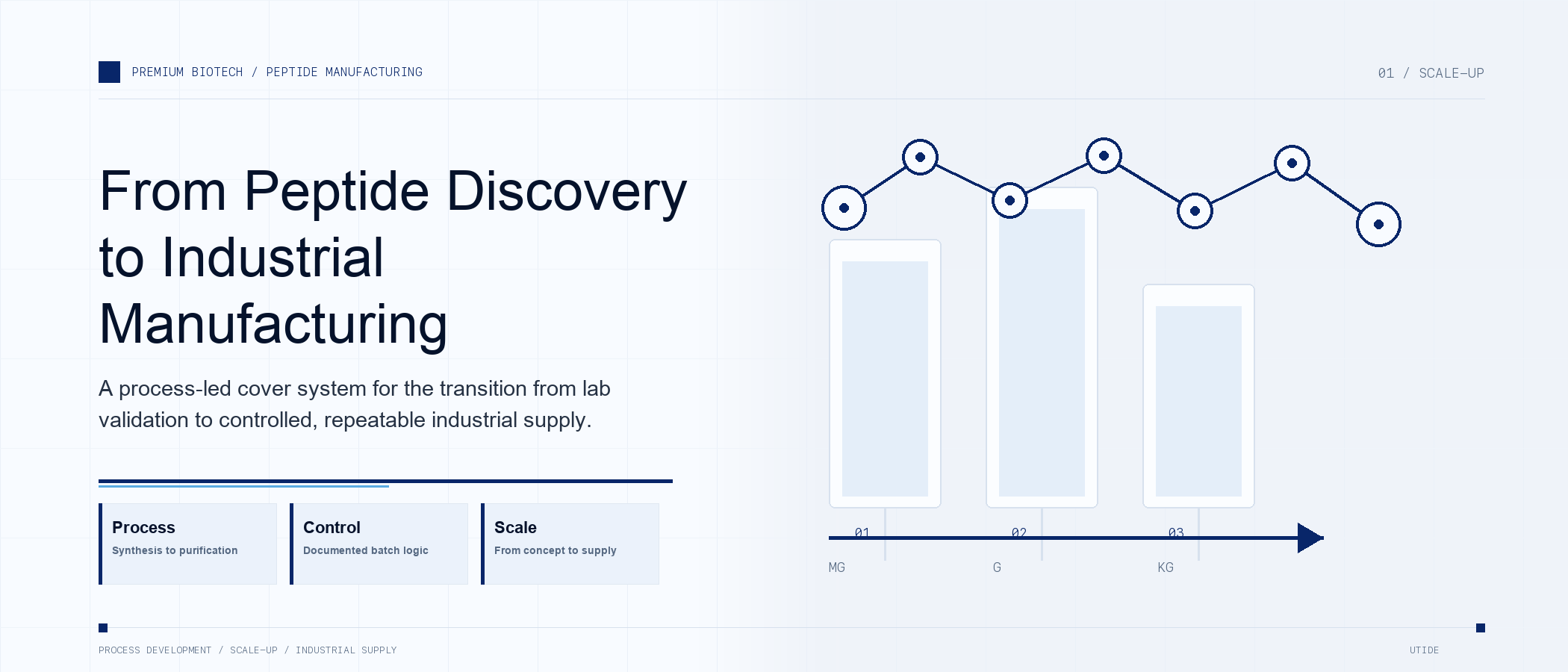
Understanding how global peptide growth is reshaping expectations for scalable manufacturing, quality systems, and long-term supply partnerships.
The global peptide industry is entering a new stage of growth. As peptide-based therapies, research programs, and advanced molecular platforms continue to expand, the demand for reliable peptide manufacturing is becoming stronger and more diverse.
For global partners, this growth creates new opportunities. It also raises an important question: how should companies evaluate peptide manufacturing partners in a market where project complexity, quality expectations, and supply requirements are all increasing?
Peptide manufacturing is no longer only about producing a target sequence. It is increasingly about building a scalable, quality-driven, and responsive supply system that can support projects from development to larger-scale manufacturing.
A Growing Market with Higher Technical Expectations
Peptides are attracting strong attention across multiple fields, including metabolic health, oncology, immunology, diagnostics, and advanced research applications. At the same time, the molecules themselves are becoming more complex.
Many projects now involve long-chain peptides, modified peptides, conjugated structures, difficult sequences, or molecules that require more advanced purification and analytical strategies. As a result, manufacturing partners are expected to provide more than basic synthesis capability.
Global customers increasingly need partners who understand process development, scale-up, impurity control, purification strategy, lyophilization behavior, documentation, and quality system requirements. This shift is changing how peptide manufacturing partnerships are evaluated.
From Product Supply to Project Support
In the past, many supplier relationships were built around a simple question: can the product be made? Today, global peptide projects often require a more comprehensive form of support.
Customers may need help optimizing a process, improving yield, controlling specific impurities, increasing batch size, preparing technical documentation, or building a stable supply plan for long-term use. In this context, a manufacturer is not only a supplier, but also a project partner.
This is especially important when a project moves from early-stage research to pilot-scale or commercial-scale supply. At each stage, the expectations for process robustness, analytical data, batch consistency, and delivery reliability become higher.
What Global Partners Should Consider
When selecting a peptide manufacturing partner, price and lead time are important, but they should not be the only factors. A low-cost or fast sample may not be enough to support a project that requires consistency, traceability, and future scale-up.
Global partners should also consider several key dimensions:
- Process development capability for complex or difficult peptide sequences
- Scale-up experience from small-scale batches to larger manufacturing requirements
- Purification expertise for high-purity and impurity-sensitive projects
- Analytical capability covering purity, impurity profile, residual solvents, counter ions, and related quality attributes
- Batch documentation and traceability to support project review and quality evaluation
- Communication efficiency and technical responsiveness throughout the project lifecycle
- Supply continuity for customers who require repeated or long-term deliveries
These factors can directly influence project timelines, technical risk, and the stability of future supply. For customers working in regulated, development-oriented, or international supply chain environments, they are often as important as the product itself.
Quality and Documentation Are Becoming More Important
As peptide projects become more global, customers are paying closer attention to quality systems and documentation. A peptide product must be supported by reliable data, clear batch records, and traceable manufacturing information.
This does not mean that every project has the same regulatory requirement. However, it does mean that customers increasingly expect transparency, consistency, and a clear understanding of how the product was manufactured and tested.
For manufacturers, this requires strong coordination between production, quality control, quality assurance, and project management. The ability to provide analytical data, explain quality results, and maintain consistent documentation is becoming a key part of global competitiveness.
Supply Chain Reliability Is a Strategic Factor
The growth of peptide demand also places greater pressure on supply chain reliability. Customers need partners who can support not only one batch, but repeated production, stable lead times, and responsive communication when project requirements change.
A reliable peptide manufacturing partner should be able to manage raw material coordination, manufacturing scheduling, quality release, packaging, and logistics with a clear project mindset. For international customers, this reliability helps reduce uncertainty and supports long-term planning.
In many cases, the strength of a manufacturing partnership is measured not only by technical capability, but also by the ability to deliver consistently over time.
Global Engagement Helps Manufacturers Understand Customer Needs
As peptide manufacturing becomes more international, direct communication with global customers is increasingly valuable. Industry exhibitions, technical meetings, and cross-border partnerships allow manufacturers to better understand market expectations, project challenges, and evolving customer requirements.
Through international platforms such as CPHI exhibitions, manufacturers can engage with pharmaceutical companies, biotech firms, CDMO partners, research organizations, and supply chain stakeholders from different regions. These conversations help connect manufacturing capability with real project needs.
For companies serving global peptide projects, international engagement is not only a marketing activity. It is also a way to understand how customer priorities are changing across quality, scale, documentation, cost, delivery, and long-term cooperation.
UTIDE’s Perspective on Global Peptide Manufacturing
At UTIDE, we believe that the growth of the peptide industry will continue to raise expectations for manufacturing partners. Customers will increasingly look for partners who can combine process development, scalable production, purification expertise, quality control, and reliable project communication.
UTIDE focuses on supporting global peptide projects through quality-driven manufacturing, scalable process execution, and integrated project support. As we continue to connect with global partners through international industry platforms, our goal is to better understand customer needs and provide manufacturing support that fits the future of peptide development.
The growing demand for peptide manufacturing is not only a market trend. It is a signal that the industry needs stronger, more reliable, and more technically capable manufacturing partnerships.
As peptide innovation continues to expand, global partners will need more than a supplier. They will need a manufacturing partner who can help turn project potential into stable, scalable, and reliable supply.